Case Study 02
Courts.ie Redesign & Family Law
Making complex legal processes easier to understand by redesigning the Courts.ie ecosystem around accessibility, clarity and user needs.
- Role
- Product Designer
- Areas
-
UX Design
Accessibility
Information Architecture
Front-end Development - Years
- 2017–2019
Overview
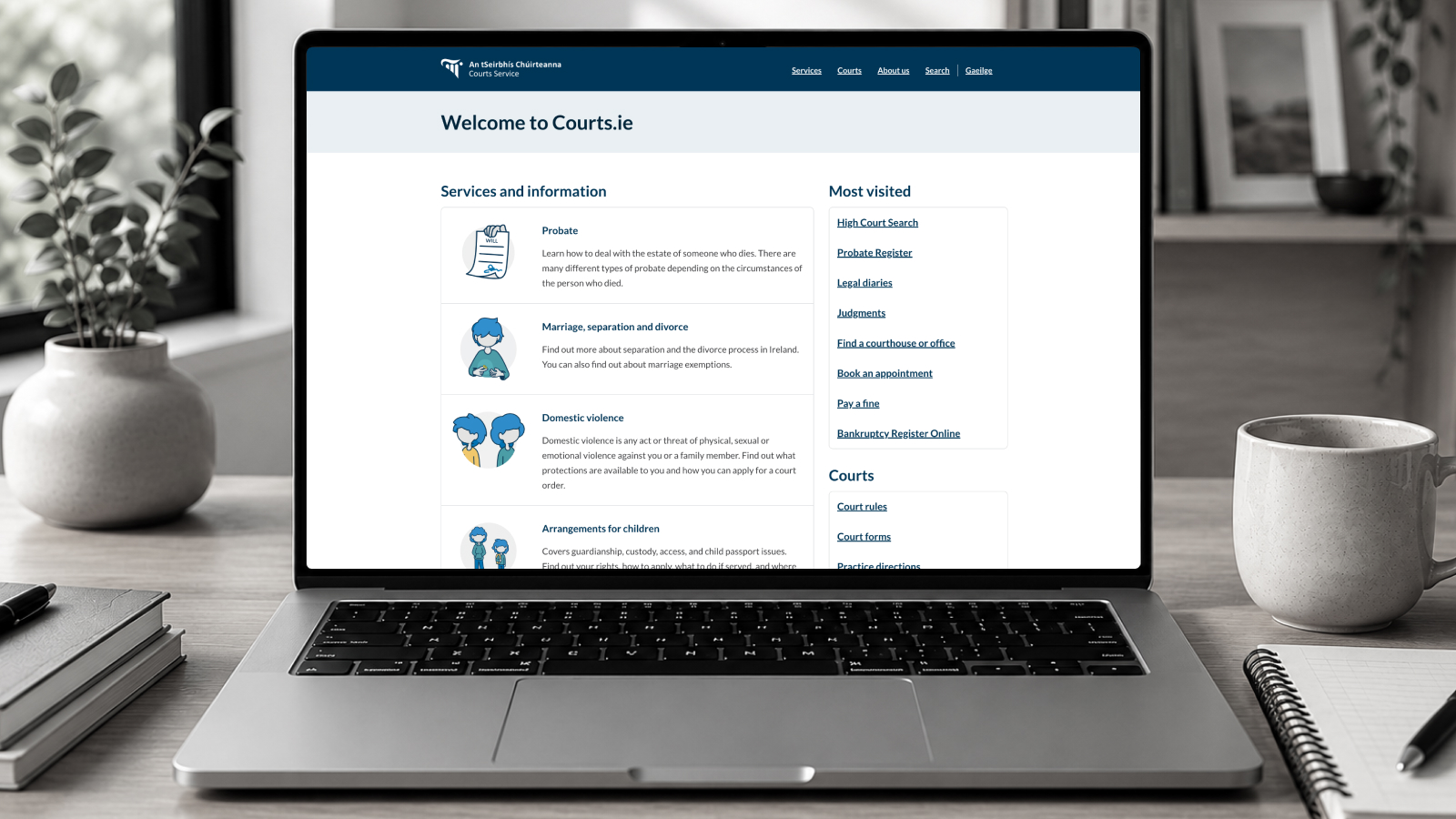
The redesign of Courts.ie began with Family Law. The objective was straightforward but ambitious: make complex legal information accessible to people navigating some of the most challenging moments of their lives.
This required translating legal procedures into intuitive, plain-English digital journeys for everyday citizens, while continuing to support the significant volume of traffic generated by legal practitioners.
The work ultimately grew beyond Family Law, becoming the foundation for the wider redesign of the Courts.ie digital ecosystem.
Family Law
The North Star: Accessible Law
The initial focus of the project was Family Law, an area characterised by emotionally charged, highly complex user journeys.
Our goal was to help users understand legal processes, locate relevant services and complete tasks without requiring specialist legal knowledge. The challenge was not simply making content easier to read, but making the broader system easier to understand and navigate.
Hypothesis & Validation
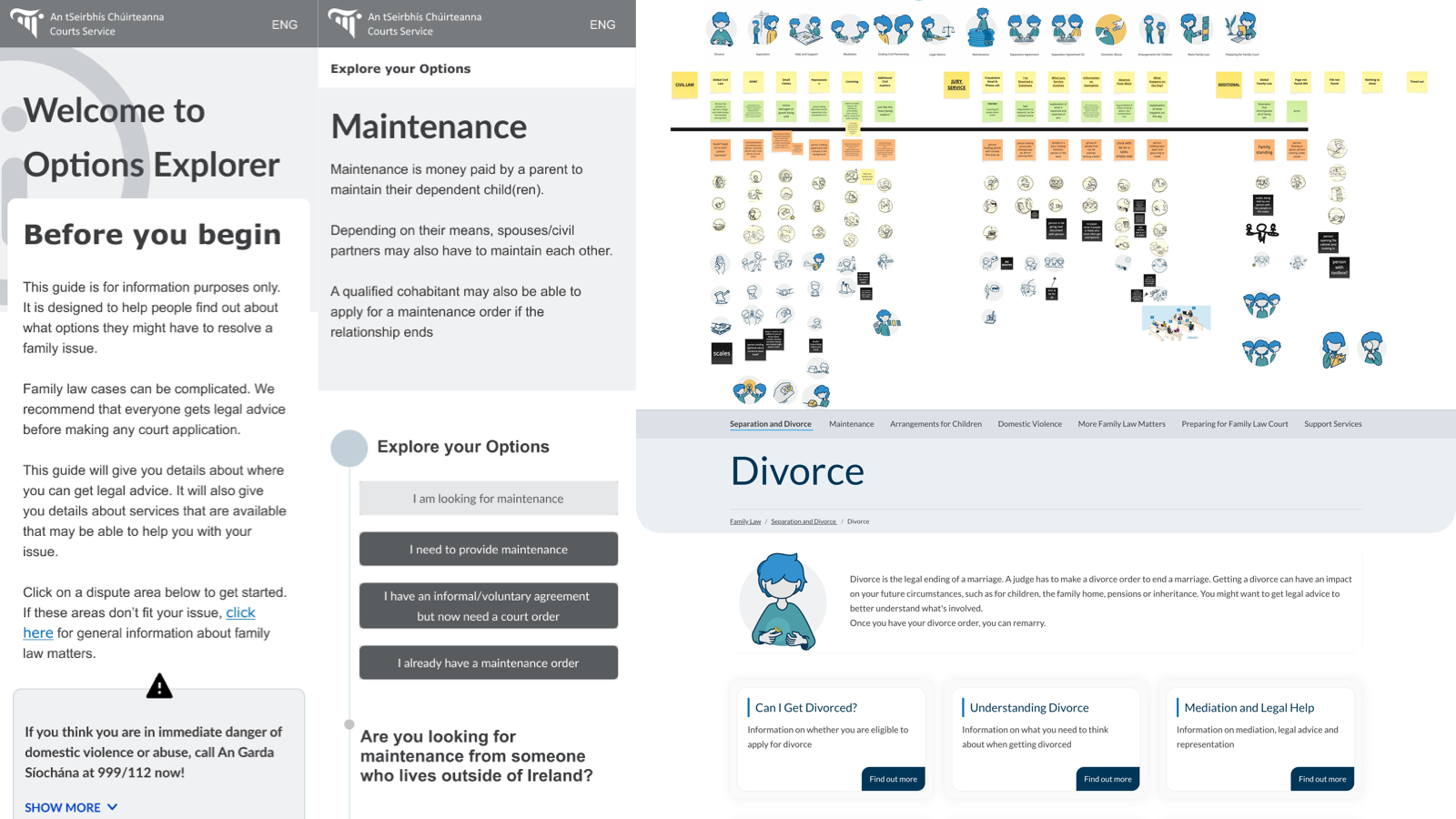
The original concept centred around a guided wizard designed to funnel users towards relevant information and services.
However, remote moderated user testing quickly challenged this assumption.
A wizard assumes a linear journey with a definitive end. Separation and divorce rarely follow a linear path. Research showed that users frequently entered the site from search engines, often landing deep within the information architecture.
Forcing those users into a predefined journey removed essential context and weakened their understanding of where they were within the broader service.
As a result, the wizard approach was abandoned in favour of a more flexible information architecture that supported multiple entry points and non-linear exploration.
Trauma-Informed Visual Language
Reducing cognitive load and anxiety became a key design principle throughout the project.
Functional HTML, CSS and JavaScript prototypes were developed using a calming colour palette, generous spacing and soft, rounded interface elements to create a more approachable experience.
A deliberate decision was made to avoid stock photography.
For highly sensitive topics such as separation, custody and divorce, photography can unintentionally introduce emotional triggers, reinforce stereotypes or fail to represent diverse family structures.
Instead, we collaborated with an illustrator to develop a bespoke visual system of abstract, gender-neutral characters. These illustrations provided helpful context while remaining inclusive, respectful and emotionally neutral.
Scaling Courts.ie
Building the Foundation
Patterns developed for Family Law ultimately became the foundation of the wider Courts.ie design system.
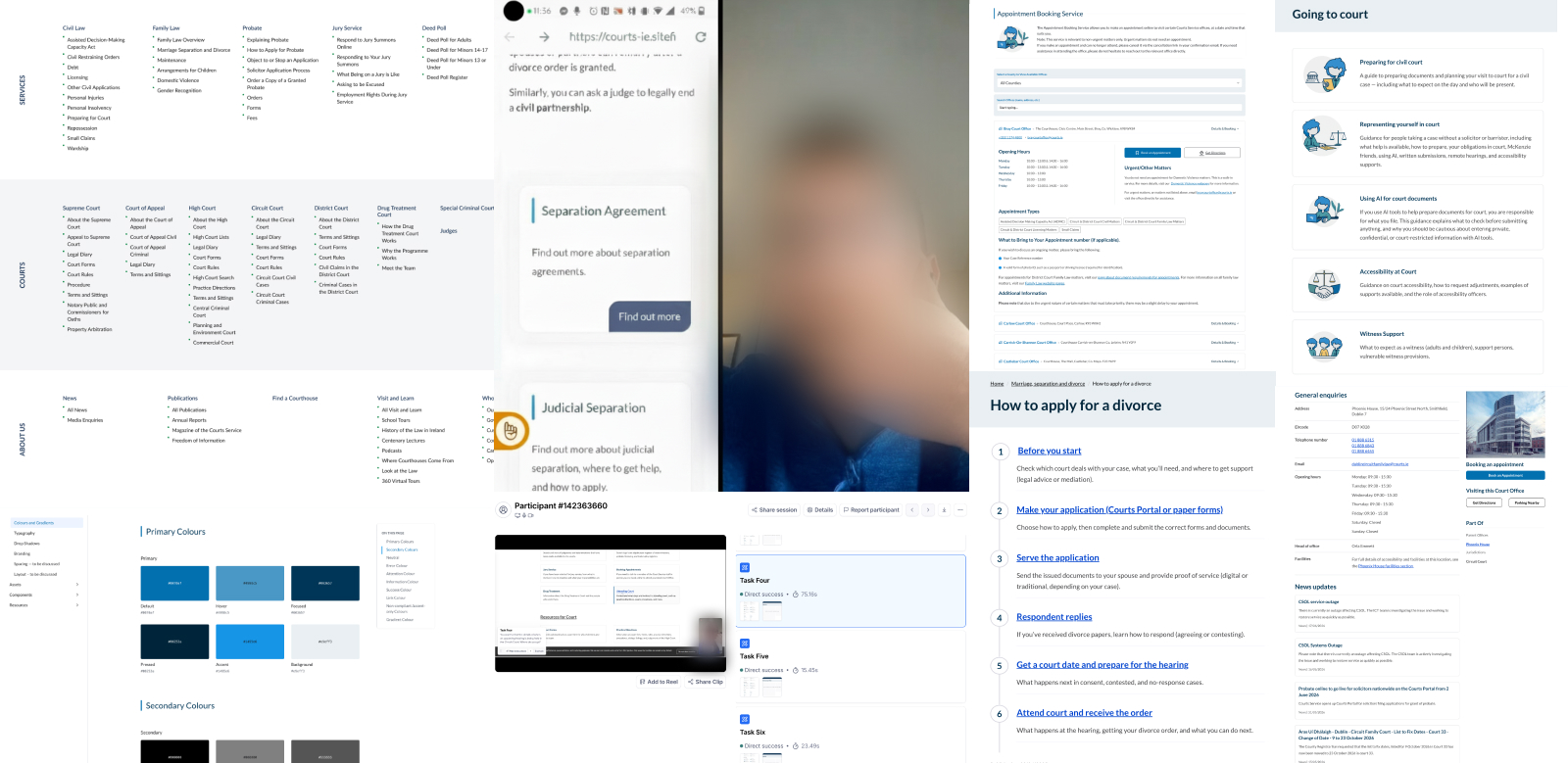
Working closely with content specialists and subject matter experts, we reviewed the existing information architecture and identified significant opportunities to simplify navigation and content discovery.
Deeply nested categorisation structures were replaced with a flatter architecture informed by search behaviour, analytics data and common user journeys.
Inspired by the clarity of Gov.uk, complex chronological processes were transformed into accessible step-by-step guides that better reflected how users sought information in practice.
This work also established clear content models for guides, services, forms, news content and landing pages, creating a scalable framework for future growth.
Homepage Strategy
One of the largest challenges was balancing the needs of two very different audiences.
Members of the public typically arrived seeking guidance and support around legal processes, while legal practitioners often required rapid access to specialist resources and operational information.
The homepage was designed around observed user behaviour rather than organisational structure.
The upper section intentionally separates these needs: plain-English guides are surfaced prominently for citizens, while high-demand practitioner resources are made immediately accessible through a dedicated “most visited” area.
Below this, navigation cards are ordered according to traffic demand rather than internal hierarchy, allowing content teams to continuously adapt the experience through the CMS as user behaviour evolves.
Accessibility & Technical Implementation
Accessibility was a core principle throughout the redesign rather than a final-stage compliance exercise.
Close collaboration between design and development ensured that visual concepts were translated into semantic HTML structures, accessible interaction patterns and robust screen-reader support.
Significant attention was paid to content hierarchy, keyboard navigation, focus management and overall usability across assistive technologies.
The final platform achieved a 100% compliance score during the National Disability Authority (NDA) accessibility scan.
Reflection
Courts.ie reinforced the importance of designing for emotional as well as functional needs.
Accessibility is often discussed in technical terms, but this project demonstrated that reducing anxiety, providing context and supporting non-linear journeys can be equally important in helping people successfully complete complex tasks.
The project also highlighted the value of combining user research, content strategy, information architecture and accessibility into a single design process. By treating these disciplines as interconnected rather than separate activities, we were able to create a more resilient and inclusive digital service.