Case Study 03
Search, Portals & Digital Services
Designing search experiences, judiciary portals and digital services that make complex legal information easier to find, navigate and understand.
- Role
- Product Designer
- Areas
-
UX Design
Accessibility
Information Architecture
Front-end Development - Years
- 2022–2026
Overview
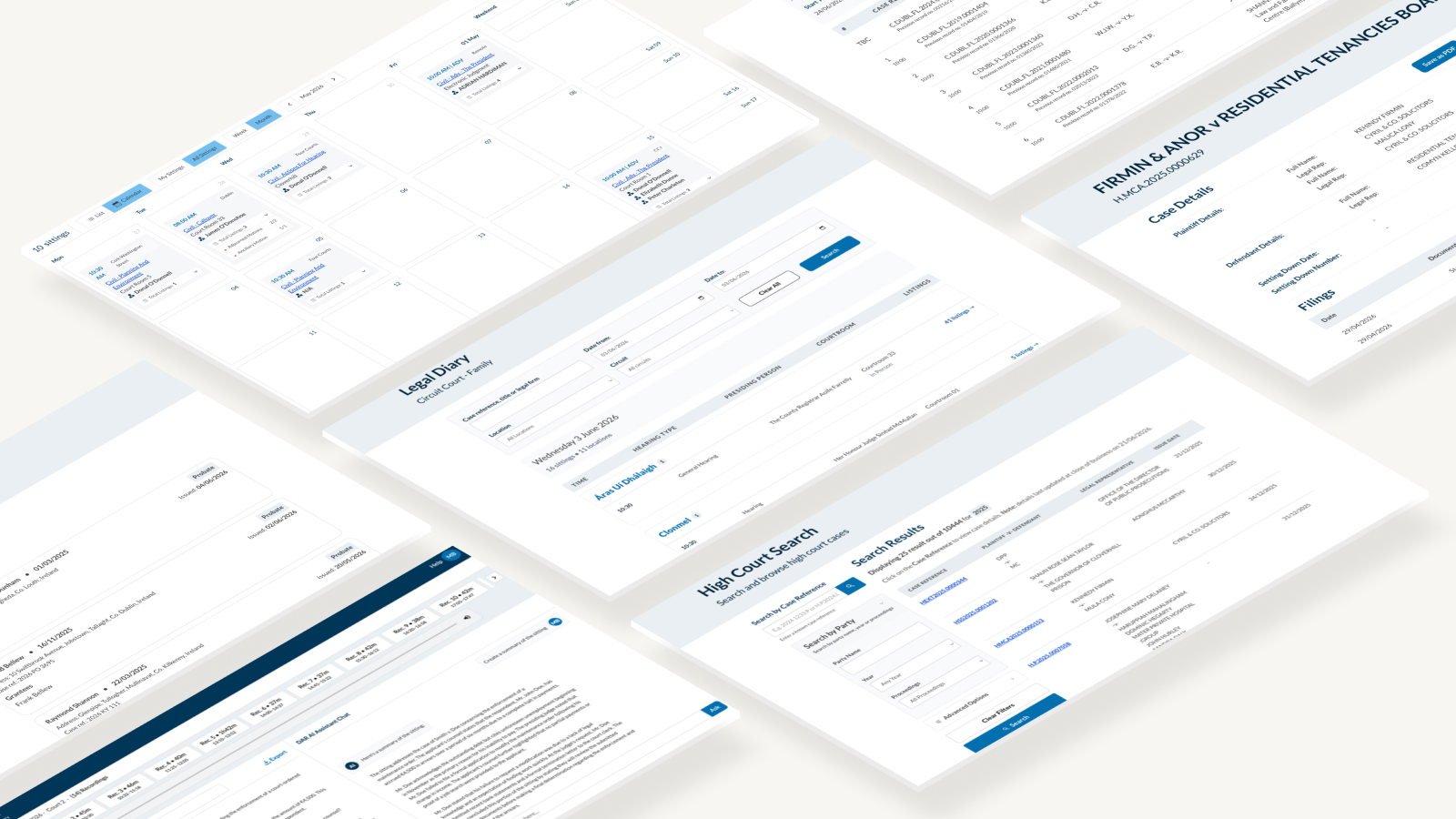
Across multiple Courts Service platforms, a common challenge repeatedly emerged: large volumes of legal information were becoming increasingly difficult to navigate.
These projects focused on transforming structured data into usable digital services through search, filtering, information architecture and progressive disclosure. The work spans public-facing services, judiciary portals and emerging AI-assisted workflows, all built on the same principle: helping users retrieve the right information with the least possible effort.
Legal Diaries
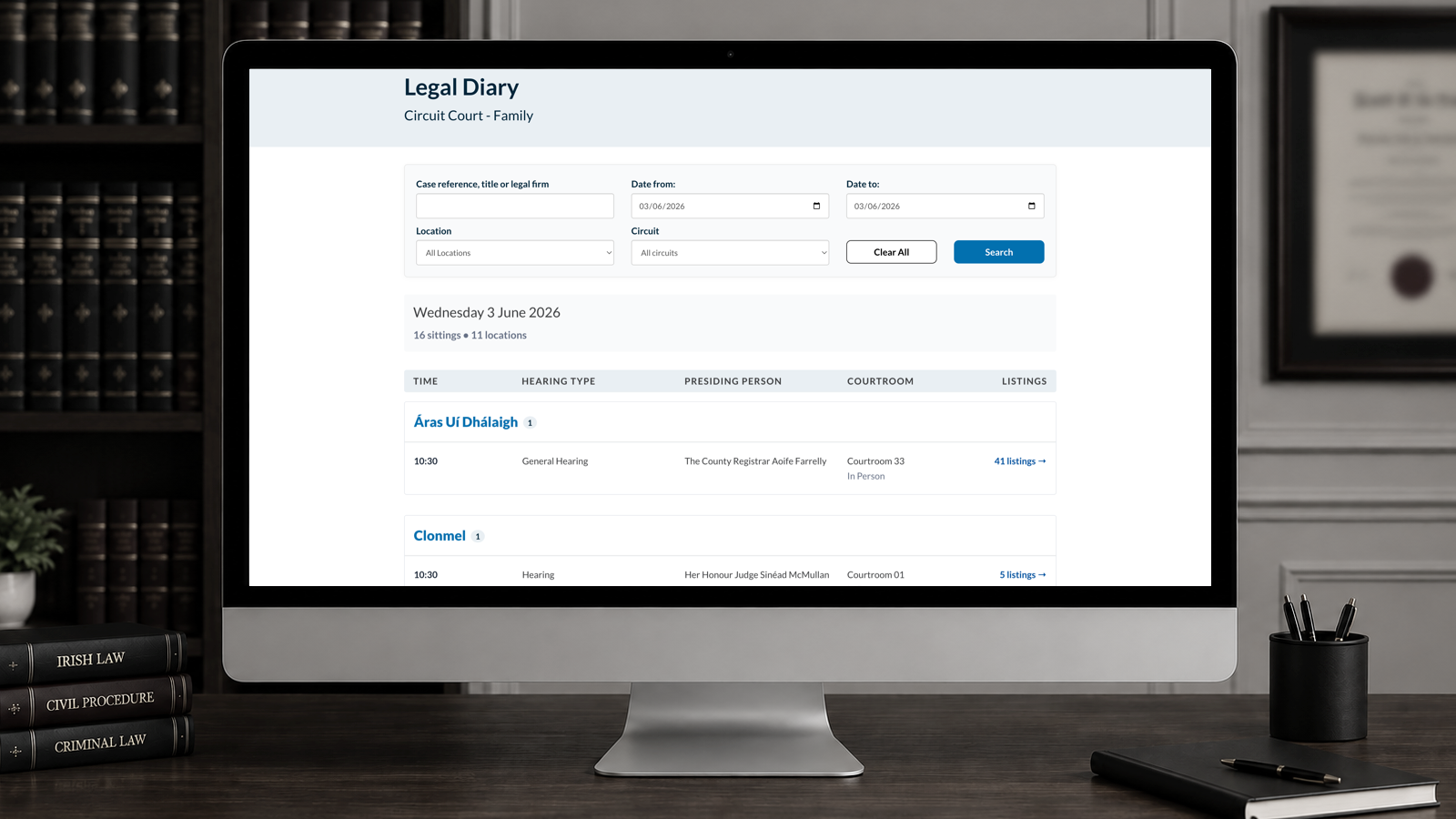
The Legal Diary became the first opportunity to apply structured case data to a public-facing search experience, transforming static schedules into a searchable and filterable service.
From Legacy Lists to Structured Search
Prior to the digital transformation of case management, the Circuit Court Family Law legal diary was published through an archaic workflow. Schedules were distributed as raw text outputs generated from Lotus Notes, making the information difficult to navigate and impossible to search effectively.
The introduction of a Unified Case Management System created the foundation for a completely new experience. Structured data models replaced unstructured text outputs, allowing legal diary information to be organised, filtered and surfaced dynamically.
Layered Information Architecture
To manage the complexity of legal scheduling, a two-layer content architecture was introduced. Users are initially presented with location sittings, providing a high-level overview of activity across the courts. Individual listings remain available as a secondary layer, reducing visual clutter while preserving access to detailed information.
Search & Filtering
The move to structured data unlocked advanced filtering capabilities across locations, judges, hearing types and schedules. What was previously a static document became a dynamic retrieval tool capable of supporting both occasional users and legal professionals.
Public Data Retrieval
The patterns established in Legal Diaries were subsequently expanded into broader public search services, enabling users to retrieve legal information quickly through consistent search and filtering experiences.
Standardising Search Experiences
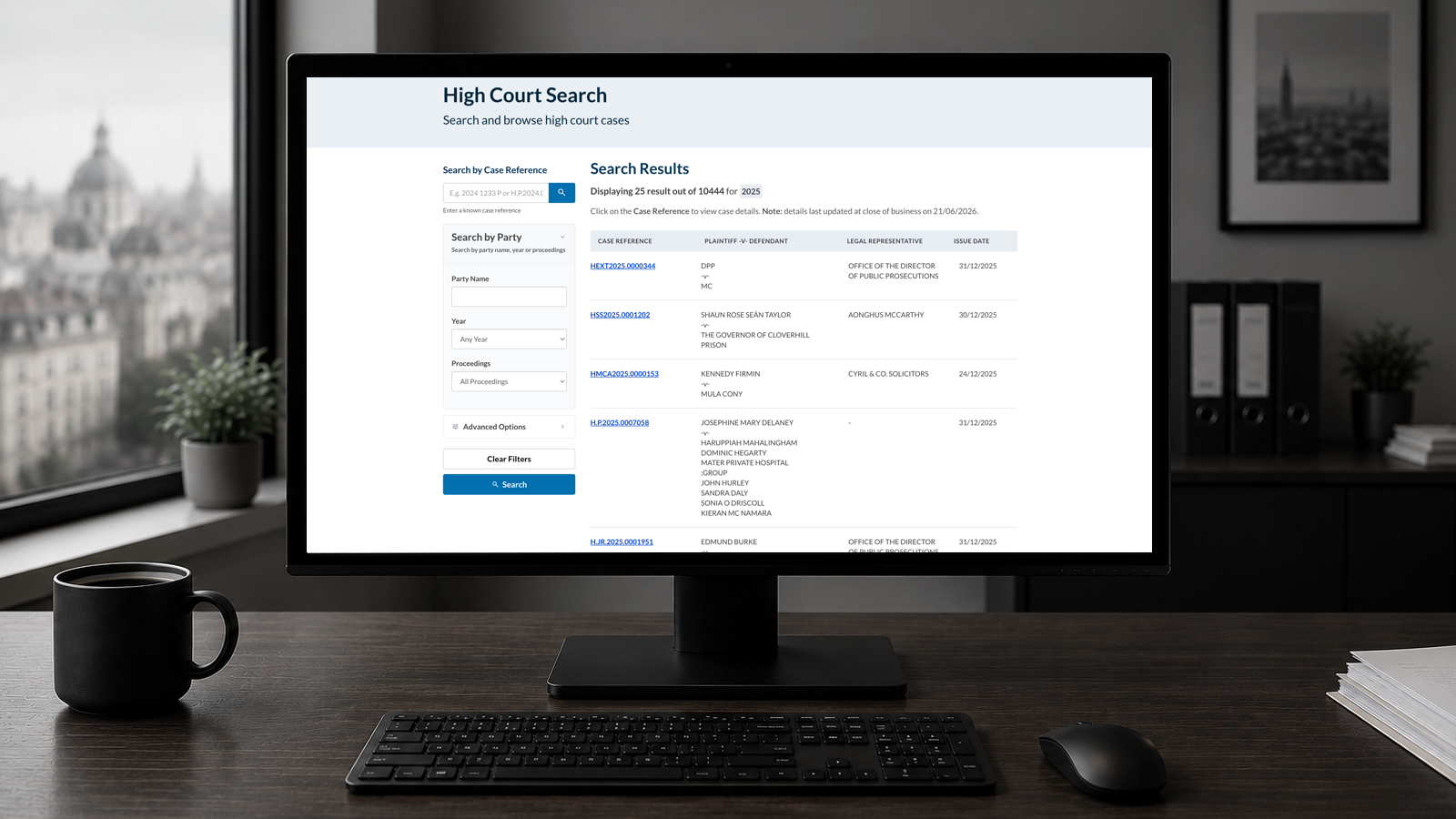
Following the successful introduction of structured data systems, a consistent search architecture was applied across several public-facing services including the Probate Register and High Court Search.
These tools enable users to retrieve highly specific legal information while maintaining a consistent interaction model across the wider ecosystem.
High Court Search Refactoring
User research revealed that the majority of searches were driven by known case references or specific party names. Existing workflows exposed large volumes of legal data without sufficient hierarchy, creating unnecessary cognitive load.
The search experience was redesigned around observed behaviour patterns. Filtering controls were streamlined and aligned with updated design system components, while case details were reorganised into structured sections that improved readability without reducing data density.
Judiciary Calendar
The same structured data model later enabled scheduling tools for judiciary staff, providing a high-level overview of court activity while preserving access to detailed listing information.

Managing High-Density Scheduling
A dedicated calendar interface was developed for judiciary staff to manage and review sittings across weeks and months. The challenge was to surface large volumes of scheduling information while maintaining clarity and scannability.
Progressive Disclosure
Each sitting is represented by a compact card displaying essential metadata including time, location, sitting type and courtroom. Additional information can be revealed on demand without disrupting the broader calendar view.
This approach enables users to maintain a high-level overview while still accessing the detail required for operational planning.
DAR AI Assistant
Once transcripts and recordings became structured and searchable, AI-assisted retrieval became a natural next step, allowing users to interrogate hearing content through summaries and contextual queries.
AI-Assisted Transcript Analysis
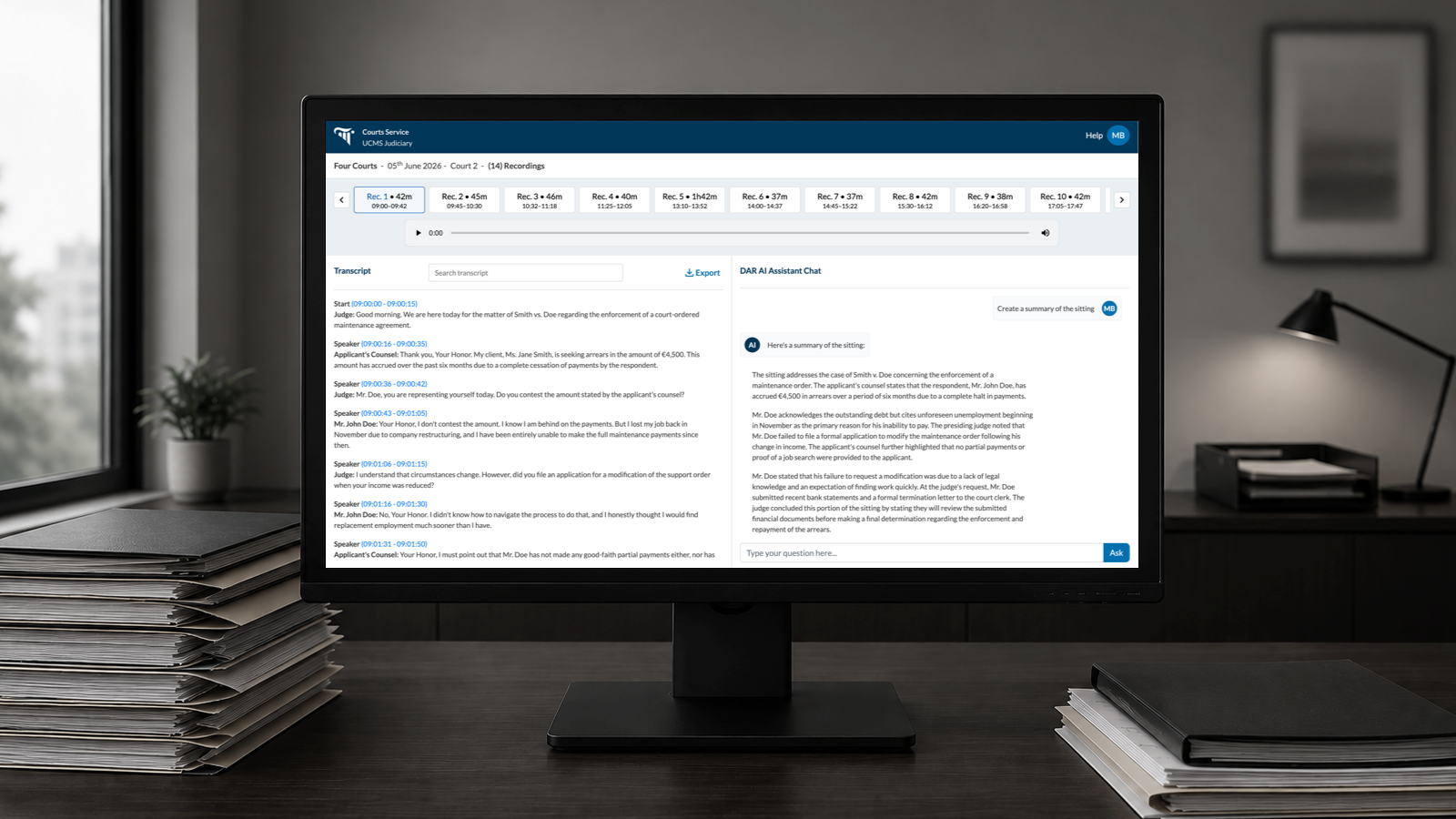
Within the secure judiciary portal environment, a DAR AI Assistant was developed to support post-hearing workflows. The interface combines audio recordings, synchronised transcripts and conversational AI within a single workspace.
Contextual Retrieval
Multiple recordings can be reviewed within a single sitting, while transcripts remain searchable and time-linked to the source audio.
A dedicated AI assistant allows judiciary users to summarise hearings, identify key participants and retrieve contextual information directly from the transcript, significantly reducing the manual effort traditionally required to analyse lengthy proceedings.
Reflection
Looking back across these projects, the common challenge was never the interface itself. The real challenge was making sense of complex systems, fragmented data and decades of accumulated processes.
Whether redesigning Legal Diaries, refactoring High Court Search or introducing AI-assisted transcript analysis, the most successful outcomes came from simplifying the underlying structure before attempting to simplify the interface.
These projects reinforced my belief that information architecture is often the most important layer of product design. When content is structured well, navigation becomes clearer, search becomes more effective and advanced capabilities such as AI can be introduced naturally rather than forced into the experience.
Ultimately, the work demonstrated that modernisation does not require abandoning familiar workflows. The most effective solutions respected the mental models of existing users while making complex systems easier to understand for everyone else.